We call this thing we do “writing,” but actually putting words down on paper is only a fraction of the work. If all it took to write well was the coordination to shape letters with a pen, the world would be packed to its limit with excellent books, and we would all have to retire. The difficult work of writing doesn’t happen on the page, but in the mind. Shaping letters isn’t the hard part: it’s shaping ideas that takes skill.
That process is made all the more difficult when you misunderstand it. If you’ve come to believe that inspiration is an unpredictable gift from the gods, that you have to wait for it to strike, then you’ll spend a lot of time sitting frustrated in front of a blank page. But what else are you supposed to do?
After all, not every idea is worthy of including in your work. Most of what runs through the human mind serves some purpose, but wouldn’t be very interesting to read about. So how do you turn the lead of mundane experience into the gold of an inspiring idea?
This post will outline a method by which you can get usable ideas for your story at any time, in any place, as long as you can focus your attention on the task. It contains three exercises, which I would encourage you to try out before reading past them, if you have the time. Cumulatively, the exercises shouldn’t take more than a half-hour to complete.
The Basic Process
In order to shape ideas, you have to have ideas. Once you have them, you need to know how to manipulate them, to break them down and reassemble them into the shapes you need for your story. Only after you’ve done all that do you have to worry about the writing part, the process of recording those ideas so that other people can understand them.
We’ll start with the first step, the gathering of ideas. We get our ideas from the world around us, through our physical senses… but more often than not, that information never really registers.
Seeing Past what we Know
In our daily lives, we’re constantly receiving a flood of information from our senses, and the demands of life require us to process it very quickly. When you see a large animal in the woods, you don’t have time to admire how the light shines through its fur. You’re too busy figuring out if you should play dead, climb a tree, or try to make yourself look big.
Those decisions rely on semantic information, or information related to what things mean, what their purposes and roles are, and how we classify them. To know how to respond to the aforementioned woodland creature, you need to know if it’s a bear, a moose, a mountain lion, or wolf. In daily life, we make most of our decisions based on semantic information. While we’re thinking in that mode, we rely on our unconscious mind to take in the flood of sensory detail from the world and refine it into meaningful ideas. Those meaningful ideas, the final products of perception, become the focus of our attention.
And when we can’t immediately translate the information from our senses into an idea, it can be unnerving. Think of that moment of uncertainty you experience when you see something pale and formless skittering across your lawn, before you realize that it’s a plastic bag blowing in the wind. Receiving raw sensory information without being able to assign meaning to it, to name it and explain it, is a rare enough experience in modern life that most people aren’t prepared for it when it happens.
But for a writer, being able see past the names and explanations, to access that raw sensory information, can be extremely useful. Those hidden details, which we overlook hundreds of times in the course of daily life, are valuable sources of material.
Material
What do I mean by material?
Imagine you’re a chemist, and you want to turn wood into candy. You know that there are glucose (sugar) molecules in the wood, but they’re all tied together in this stuff called cellulose, which is tough and fibrous. So in order to get the sugar molecules out of the wood, you first have to break down the wood and extract the cellulose, then break down the cellulose to extract the glucose. Then you can melt it down, add flavorings, and mold it into your preferred shape. Voila! Candy.
For the chemist, the material they’re trying to get to is the glucose. They have to break the wood down into it before they can start mixing in new things to make candy. For a writer, the process is similar. Instead of working with chemicals, though, we work with ideas. To get our material, we take a complex idea, in which the sensory information is all bound up in semantic structures, and we break it down into more ambiguous, malleable mental material.
For example, think of a car. The idea of a car carries a lot of semantic information. We know its purpose: to move people from one place to another. We know that it needs a power source, and some way of pushing itself along the ground. We know that there has to be somewhere for a driver to sit, and that they need a clear windshield so that they can see where they’re going.
But if you look past the semantic information, you can find interesting sensory information, too. You could get a close look at the tire tread, for example, and see the intricate pattern of plateaus and canyons in the rubber surface. That bit of sensory information is good material because it’s flexible. The pattern you see doesn’t need to be part of a car tire. It could be an alien writing system, or the map of artificial rivers created by an advanced society, or the veins carrying blood through the body of a giant. In order to see those possibilities, though, you first need to separate the sensory and semantic information in your mind. You need to ignore the true purpose of the tire tread, (to create friction with the road,) and come up with alternatives.
Exercise: Breaking Down an Idea
Let’s try extracting some sensory information from this cottonwood catkin.
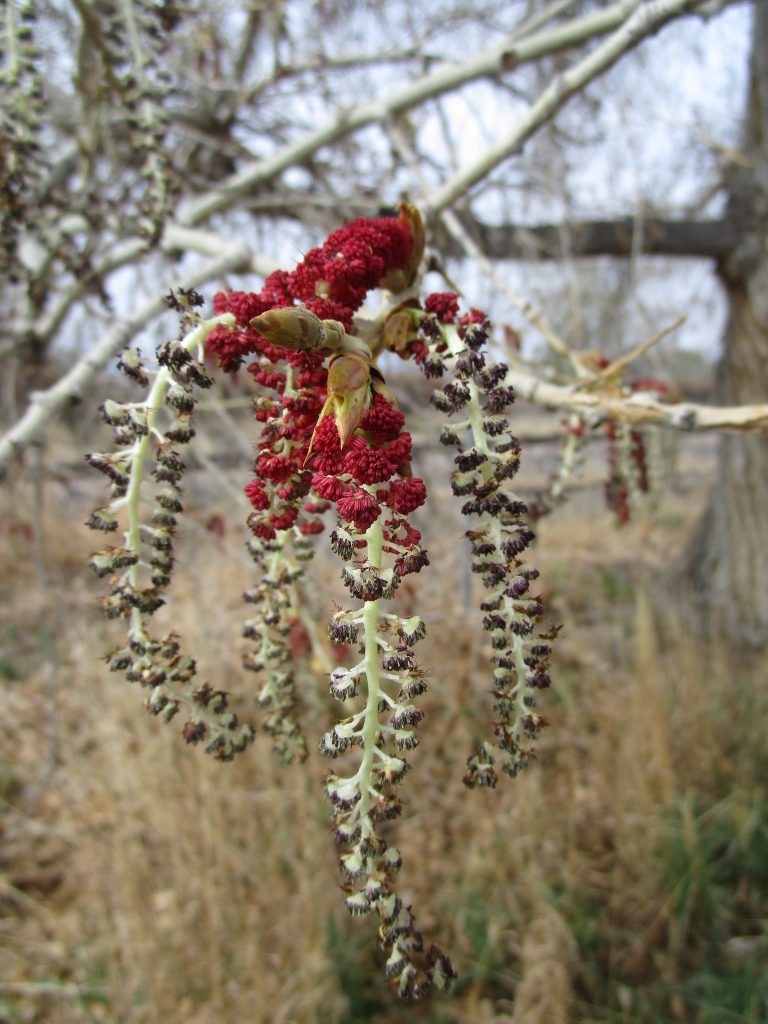
Hmmm… I think we need to get in a little closer.
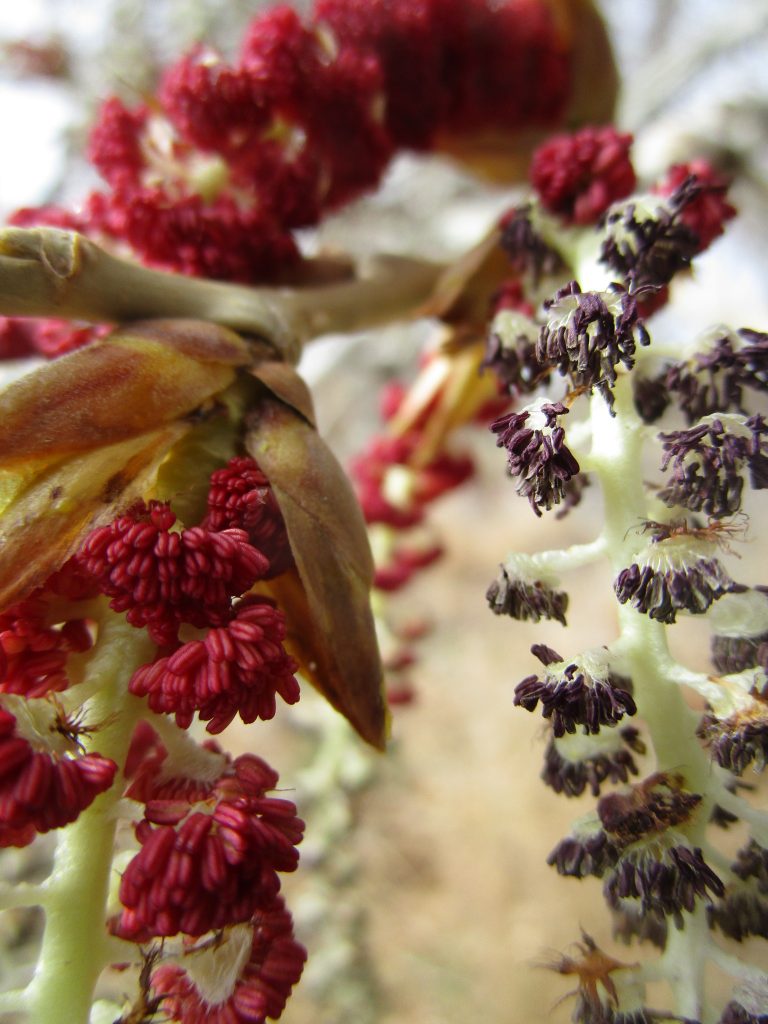
Now we’re ready to get started! Take a few moments to look carefully at this image, and write down a few pieces of sensory information. Aim to capture colors, textures, shapes and forms. You can record semantic information too, like the purpose of the flowers, or symbolic or metaphorical interpretations of what you see, but try to keep the two kinds of observations separate.
◢◤◢◤◢◤◢◤◢◤◢◤◢◤◢◤◢◤◢◤◢◤◢◤◢◤◢◤
Here’s my list:
- A pointed outer shell that can open to reveal something.
- Bundles hanging from the branches of a stem.
- That wonderful pinkish-red color of the seeds.
- The soft, springy texture of the new growth.
Making Use of Material
Now that we have our material, we can use it to make a new and interesting idea. So how do we do that?
Well, a complete idea will have both sensory and semantic information. Once we’ve separated out some sensory information from one thing, the simplest way to create a new idea is to apply it to the semantic information of something else.
Let’s return to the car tire. I separated out the pattern on the tread. To combine it with some new semantic information, I’m looking for a way to define its purpose or meaning, to name and explain it in a fresh new way. The easiest way to approach that is to think associatively. Ask yourself “what else is like this? What looks like it, or feels like it, or tastes like it?” In the case of the tire-tread pattern, I was able to quickly find three similar patterns by association: the pattern of written lines on paper, the pattern of canals running through a landscape, and the pattern of veins in a body.
Or, for more of a challenge, you can try applying the sensory information from one object to the semantic structure of another…
Exercise: Object Transmutation
For this exercise, you’ll need to have some bits of sensory information, and a semantic structure that we can apply them to. You can use the sensory details that you extracted from the cottonwood catkins, if you want, or you could choose any object nearby to extract new details from.
As for the semantic structure, the easiest to use tend to be things like person, landscape, building, vehicle, or weapon. All of these categories have certain expectations connected with them, and those expectations will shape how your sensory details manifest in them. At the same time, they’re not so specific as to leave you stumped, a problem you might have with bartender, mountain, chapel, jet-ski or halberd.
A person, for example, has certain features. We know that they’re likely to have two arms, two legs, and two eyes. We know that they could have hair, and are likely to be wearing clothes. They might carry tools or accessories as well. With all of that semantic information in mind, we can find the right roles for our sensory information to slot into. I’ll use my cottonwood details to show you how it’s done:
The pinkish-red color of the seeds could be the color of dyed hair. I could borrow the shape of the seed-clusters, too — they remind me of dreadlocks. The soft, springy texture of new growth can inform their body-type. They’re young and spry, flexible, but maybe not very tough. I’ll borrow the color from the split-open shell for their skin-tone, a kind of golden reddish-brown. The pointed shape of the shell is trickier, as long as we’re constrained to the shape of a human body. I’ll make it into pauldrons, one half-shell worn over each shoulder, with the points outward. The pointed shape of the shell could also work as the tip of a spear. With that, my cottonwood warrior is complete!
Now, it’s your turn! Choose a semantic structure, like person, landscape, vehicle, weapon, or something else, and apply your sensory details to it. You can take it as far as you want, and if you run out of details, you can always return to the source to find more.
You can pause here while you try out this exercise.
◢◤◢◤◢◤◢◤◢◤◢◤◢◤◢◤◢◤◢◤◢◤◢◤◢◤◢◤
So, how did it go? Are you happy with the results? Let me try to read your mind. You’re thinking “this is cool and all, but how would I make use of it in a real story?”
If that is what you were thinking, you’re right to ask. The process you followed in the last exercise can generate interesting ideas, but it doesn’t give you very much control over the result. You’re taking all of your sensory details from a single source, after all, so whatever you end up with will carry a lot of flavor from that original source.
When you’re working on a story already in progress, more precise control of your ideas is important. In order for an idea to fit into a story, it needs to integrate with other ideas already present, and to complement the story’s flavor.
So let’s talk about how to do that.
Fitting Ideas to Any Situation
What I’m calling flavor can be a little hard to describe. In logical terms, it’s composite experience of all of the sensory details that are part of the story. In metaphorical terms, it’s like the flavor of a soup with many ingredients. When the soup has been cooking for a long time over a low flame, what you taste is something different from the sum of those ingredients, but you can still detect the individual spices, if you have a discerning palate. Working with the flavor of ideas is more an art than a science. You have to trust your intuition.
In addition to thinking about flavor, you can make things easier on yourself by adding a little bit of semantic information to keep things structured as well. In order to clearly articulate the flavor you’re trying to add, and its semantic role, you might write a short statement like this:
A bounty hunter. Greasy, deceptive, eel-like vibes. Bravery and cowardice in conflict.
A description of what you’re looking for will help guide you to the material that best suits your needs. As you gather details, choose the ones that you think might contribute to the flavors you described, or details that would mesh with the semantic structure.
You can take that material from anything. You could use household objects, paintings at a gallery, a deck of tarot cards, or plants and animals in nature. All you have to do is carefully observe your source of inspiration, and write down any sensory or semantic information that might be useful. Once you’ve collected enough, you can pick and choose what works best.
Ready to give it a shot?
Synthesizing Fanfiction
In order to demonstrate that this method will let you fit a new idea to an existing story, we’ll need an existing story to use. You’re welcome to use whatever you’ve been writing, or somebody else’s story, as long as you know it well. Once you’ve chosen a story, decide what element you’ll add to it. You could create a new character, a new part of the setting, or anything at all, as long as it fits within what’s already there.
For my demonstration to work, though, I’m better off using a story that a large number of people are already familiar with. My goal will be to create a new robot that would fit into the world of Star Wars.
In order to create this robot, my first step was to gather material. Here’s what I ended up with:
- From a fountain pen, I took the detail that it has a clear window on the side to see how much ink remains in the reservoir.
- From a light bulb, I took the idea of a translucent glass ball.
- From an electric kettle, I took the ability to produce steam.
- From a grandfather clock, I took thin metal bars that serve as chimes.
I described my robot as follows:
A plant-growing robot. Up top, a globe of frosted glass, through which you can see the silhouette of the plant inside. Condensation fogs it up. View-ports on fuel and water tanks show the levels of both. When they get low, metal chimes jangle, but also when the robot moves. It has a Dalek-like bottom half, trash-can-shaped.
(I know Daleks are from Trek, not Wars, but I didn’t know what to do with the bottom half, and that’s what came to mind. So sue me.)
Now, it’s your turn! Here are the steps of this exercise in brief:
1) Select an existing story that you’d like to fit a new idea into.
2) Choose what kind of idea you’d like to add. It could be a character, a setting, an object, or something else.
3) Collect material from your surroundings that feels like it might fit the idea you plan to create. This material can be sensory information, like the translucent glass ball, or semantic information, like the purpose of showing how much liquid remains in a reservoir. You can collect as much material as you like, and you don’t need to use all of it.
4) Assemble your material into the new idea!
◢◤◢◤◢◤◢◤◢◤◢◤◢◤◢◤◢◤◢◤◢◤◢◤◢◤◢◤
In Closing
The three exercises included in this post are intended to give you a way to generate ideas for your fiction, yes, but also to make you more aware of where ideas come from. Inspiration doesn’t need to be something you wait for, like a bolt from the blue, and it doesn’t have to be dramatic or highly emotionally charged. Useful inspiration can be gathered from mundane sources, slowly and deliberately, until you have everything you need.
Unfortunately, that means an uncooperative muse is no excuse to slack off. If you want ideas, seek them out!
Want More?
If you’d like to be notified when I post a new blog, you can sign up for my bi-weekly newsletter. Click here, or visit contact.harrysdesk.com/newsletter
If you’re interested in hiring me on as a writing coach, you can see my rates here at my website, www.harrysdesk.com
If you want to contact me directly, you can use this contact page (https://contact.harrysdesk.com/) or email me at harry@harrysdesk.com
Leave a Reply